
This information was kindly provided from the archives of the
Scottish Railway Museum
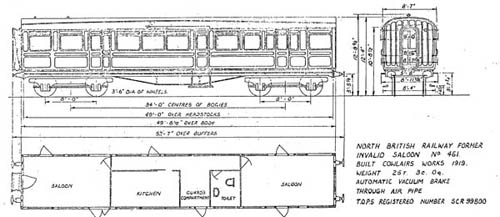
- Introduced 1919
- Length over Body 49'8'
- Width over Body 8' 6"
- Compartments - see text below
- Seating - see text
- Roof Height over rail 12' 4"
- Body Height over frame 8' 2"
- Length over Buffers 52' 7"
- Wheel Diameter 3' 6"
- Bogie Wheelbase 8' 0"
- Bogie Centres 34' 0"
- Tare Weight 25T 3cwt
- Heating Steam
- Lighting Electric
- Brake System Dual
- Gangways B. Std.
461 32283 Cowlairs 1919 21.12.57 11.1.1958 Condemned 10/72
Sold to SRPS
A link with previous North British Railway coachbuilding practice is provided in the dimensions of length
which perpetuate those of the very first North British Railway bogie carriages which were built in 1889.
From 1906 onwards, the standard length over the bodywork was standardised at 58' 4" except for special
vehicles.
The first specific reference to this vehicle appears in a Minute of the Traffic Committee dated 15th April,
1914, where the matter was noted as being delayed for further consideration. Nothing more tangible was
to emerge from the subsequent meeting of I3th May or 10th June, but at the meeting of the 8th July, the
Committee received a letter from the Supt. of the line dated 6th July, relative to the design of the
vehicle. The Traffic Committee approved of the design to Drawing No. 1222 C, modified to provide vestibule
connections.
Construction was delayed by the advent of the 1914 - 1918 War, and it is worth noting that in both the 1915
and 1916 carriage programmes a saloon was deleted from the lists. It is not definite that this vehicle
was the one in question, but certainly no move was made to commence building.
It was not until 1919 at the meeting of the Locomotive & Stores Committee held on 7th February, that the
matter of this vehicle was again raised, as part of the Locomotive Carriage and Wagon programme for the
year 1919 and arrears, and construction was ordered at Cowlairs, in the company of some 15 other vehicles.
At the same meeting, 22 other carriages were put out to contract with Messrs. Hurst Nelson & Company of
Motherwell.
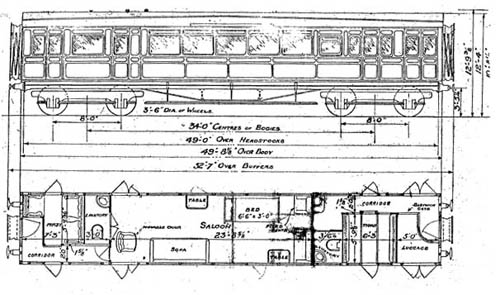
An built, the carriage had 1 First Class compartment with 3 seats, 1 Third Class Compartment with
four-a-side seating giving 8 seats, and 1 Saloon, which was classified as 'First Class' and provided 2
fixed and 1 movable chairs, a sofa and a bed measuring 6'6" x 3'0". Additionally, there were two toilets
and one luggage compartment. The access doors to the saloon were of the double type, one door being of
the standard NBR width of 2'0", the other being only 1' 3" wide, the enlarged opening being no doubt
provided to facilitate access of wheelchairs and stretchers.
Livery was the standard NBR 'Lake' colour, lettering being in shaded
characters. The word 'FIRST' appeared on both the appropriate doors
of the compartment and the saloon, the three central panels below the
large windows carrying respectively 'N.B.R.', 'SALOON', and '461'. The
word 'THIRD' appeared on the other compartment door, with the luggage
compartment doors carrying the wording 'LUGGAGE' and 'COMPT'. Two
crests were carried on each side of the vehicle in the lower panels,
adjacent to the double saloon doors and the third class doors towards
the centre line of the coach.
A bottom footboard, which originally occupied space between the bogies was ordered to be removed after
10th July, 1922. No Pullman adaptor was originally fitted to the vehicle, although this was amended later.
In the North British General Appendix for 2nd October, 1922, the coach is classified as a 'Vestibule first
saloon' with 10 First and 8 Third class seats. As such, the car passed into the stock of the L.N.E.R.
The car appears to have little altered in the hands of its new owners, although its identity
altered with the renumbering scheme of circa 1924 it became 32283, being classified as a 'composite
class' vehicle, which was more accurate than the NBR Appendix terminology. Fitted with an adaptor
to enable coupling to be effected with Pullman vestibuled stock, the Westinghouse brake gear was
removed and the vehicle thus conformed to the LNER (S.S.A.) standard of Vacuum brake only.
In 1948 it passed from the LNER to British Railways, and the number was again altered by the addition
of the prefix letter 'E'. In 1951 the coach received the new prefix 'SC', the 'E' becoming the suffix.
It was to remain in service until 21st December, 1951 when it was condemned at Cowlairs, near Glasgow,
still as a composite vehicle with 10 first and 8 third class seats. The vehicle was due for condemnation
under the 1957 Programme.
The Invalid Saloon Was taken into Cowlairs works and numerous adaptations were made to fit it out for
its new role as a District Engineer's Saloon.
The ends were removed and replaced by plain sheeting, incorporating three inspection windows, The double
doors of the luggage compartment were removed and the panelling made up. Observation windows which were
believed to be from the central part of the coach were placed in position together with the patent
ventilators from the same source. A single door was placed in the centre of the coach on each side,
and the framing adjusted to suit. A completely new interior was built, including a brake compartment,
and ironically, the new construction took place where there had been none before, the existing woodwork
being opened out into saloons! Compartment doors from the first class compartment end of the coach and
the single windows adjacent to them were also taken out and replaced by inspection windows, the lower
panelling being made up to suit.
On completion of the reconstruction work, the vehicle was renumbered as SC 320577 and surprisingly did
not acquire either the 'DE' prefix or an 'E' suffix as might have been expected to conform with standard
arrangement of the time.